Your Ad Account and Your Bank Account Disagree. Believe the Bank.
Your ad account answers a different question than the one you're asking. How to find out which ad actually paid for itself, and why it changes what you scale.
By Aaron Ball

Most owners think their ad account tells them what's working.
The reality is that your ad account tells you what your ad account can see. And it can't see your bank.
Open your ad manager and it will report purchases and a return on spend. Now open your payment processor for the same week and count the money that actually arrived. In most businesses I look at, those two numbers don't match. Sometimes they're close. Often they're not.
That gap isn't a rounding error. It's the difference between scaling the right campaign and scaling the wrong one.
Why the two numbers disagree
Ad platforms count what their tracking sees, inside their own window, using their own rules. A few things quietly inflate or scramble the count:
- Credit is claimed, not proven. If someone saw your ad and came back a week later from an email to buy, the platform may still count the sale as its own.
- Refunds never reach it. A purchase refunded on day three still counts as a purchase in the ad account.
- Long sales cycles break it. When buyers opt in, book a call and pay two weeks later, the payment often lands outside the window the platform is watching, or never connects at all.
- Plans and subscriptions get flattened. The ad account sees one event. Your bank sees the first payment, the second one and the cancellation.
None of this is the platform lying. It's the platform answering a different question. It asks, "Did our ad touch this person?" You're asking, "Which dollar of spend brought back which dollar of revenue?"
Believe the bank
The fix starts with one rule: revenue is whatever reached your payment processor. Not a reported conversion. Not an open rate. Not a cost per lead.
That rule changes how you judge everything upstream. A change that lifts opt-ins but lowers purchases is a loss, no matter how good the cost per lead looks. A campaign with expensive leads who buy beats a campaign with cheap leads who never do. Optimize a number that isn't money for long enough and you'll build a cheaper, worse business.
Follow one person, first click to payment
The only way to know which ad paid for itself is to follow the same person all the way through.
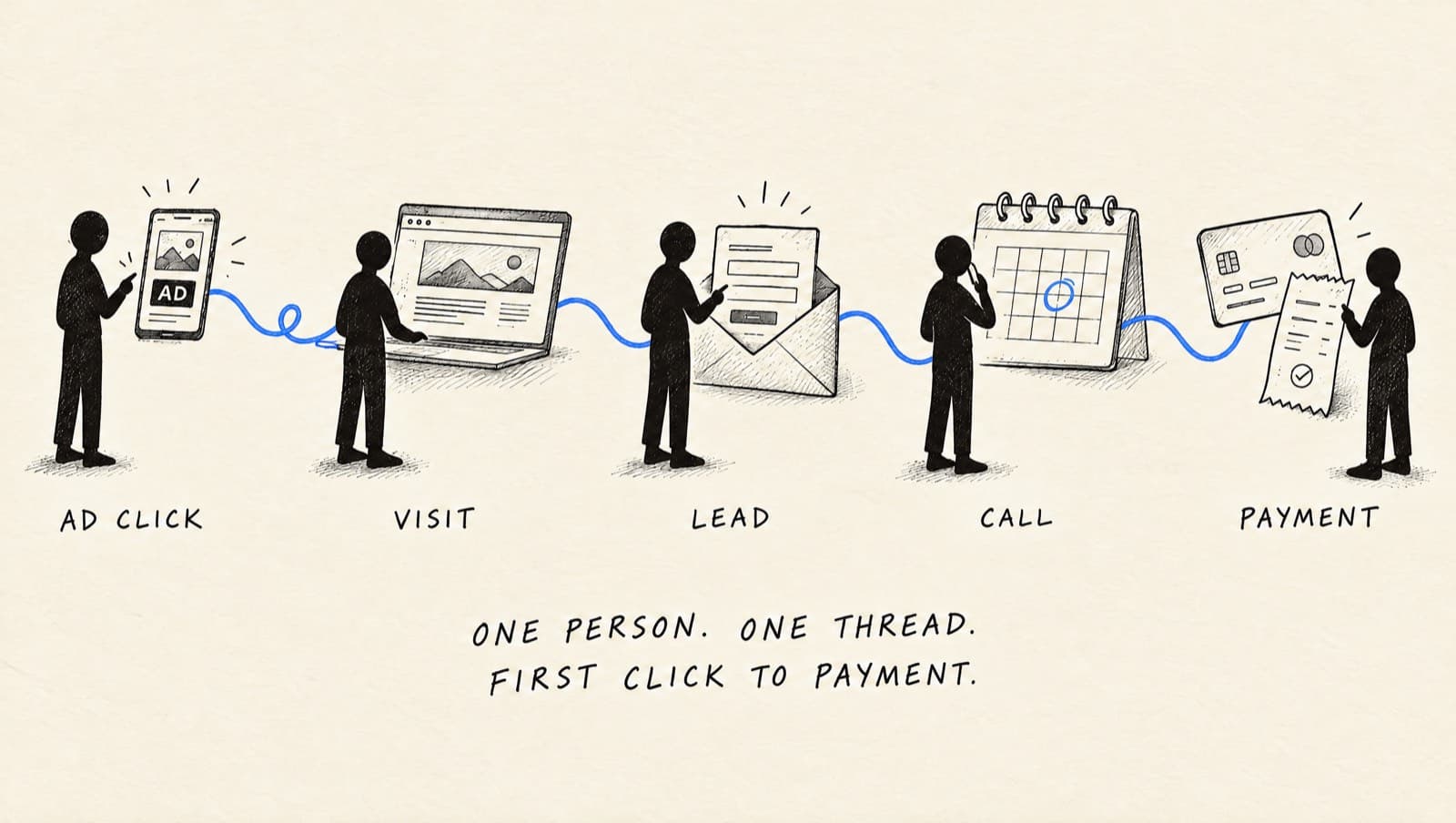
The ad they clicked. The page they landed on. The form they filled out. The call they booked. The payment they made, and whether it stuck. When those are tied together, the question stops being a debate and becomes a lookup.
Two habits make the answer trustworthy:
- Split it before you judge it, because the average lies. A campaign that "breaks even" is often one ad set carrying the whole account and two quietly losing money. Look at campaign, ad set and ad before you decide anything.
- Give it the time your buyers take. If your buyers take two weeks to pay, judging an ad after two days judges it on leads, not money.
Then teach your ad account with real buyers
Here's the second-order move most owners miss. Once you know which people actually paid, send that back to the ad platform. When it learns from real purchases (and from the applications and booked calls that lead to them) instead of cheap opt-ins, it starts finding more people like your buyers and fewer people like your freebie collectors.
Your ad account isn't the enemy. It's an employee being trained on the wrong data.
This is what Operator Mode was built to run
Operator Mode treats your payment processor as the source of truth and connects everything else to it.
Plug your business in, and one machine handles your operations, acquires new customers and brings in new revenue, run by an Operator agent that knows your business. More than 25 jobs, handled by one very powerful machine dedicated to helping you strategically grow, scale and operate your online business.
- Sales traced to their source. Every sale is tied back to the campaign, ad set and ad that brought the person in, so you can see what's working by the money it made.
- Real buyers sent back to your ad account. Leads, applications, booked calls and purchases go back to the platform, so it learns from the people who actually pay.
- Ads your Operator agent builds and you switch on. It builds the campaigns, you start the spend, and both of you tune them from live results.
- Revenue that's real. Payments, subscriptions, upgrades and cancellations, read from the payment tools you already use.
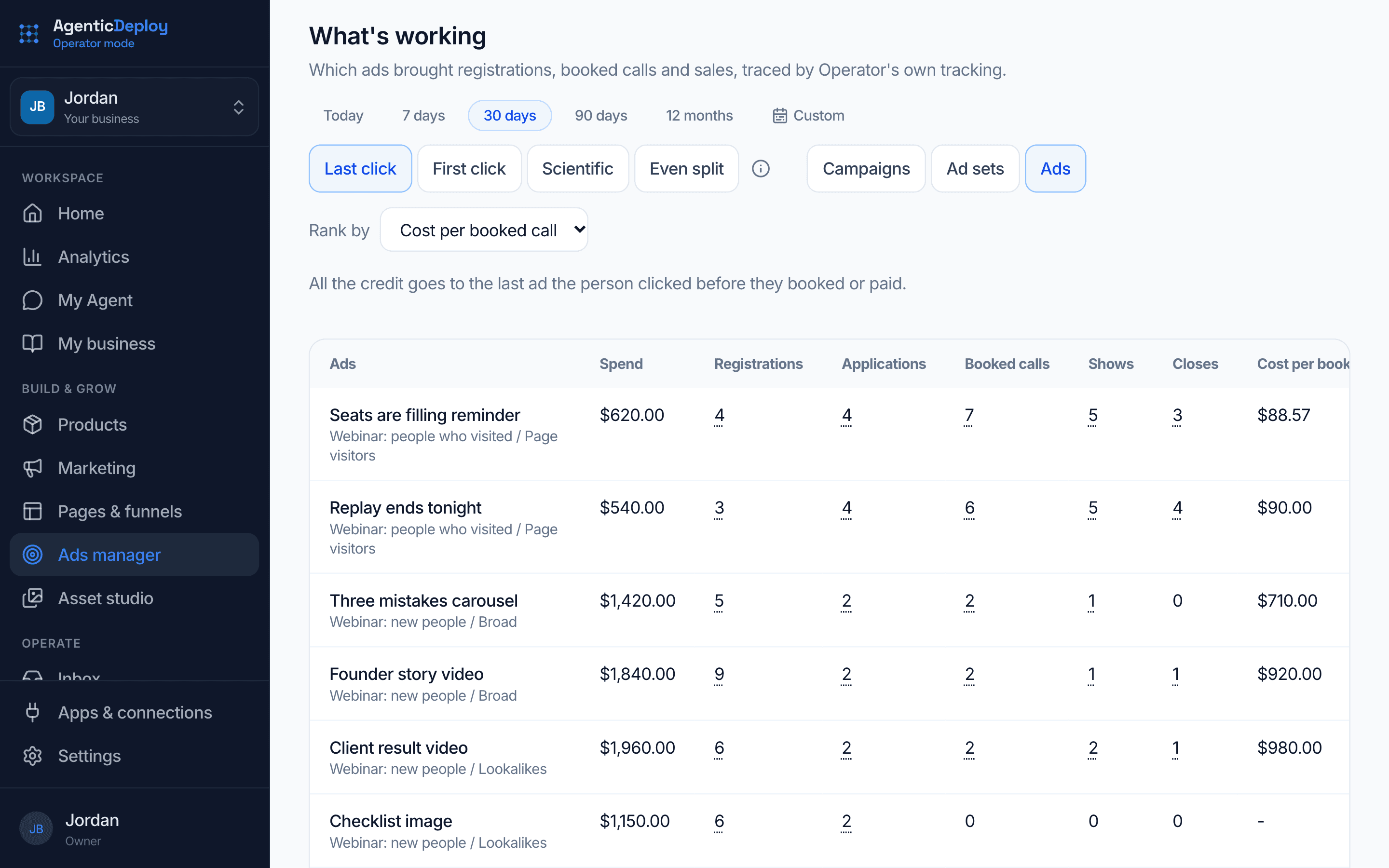
"My ad account already shows my return on spend"
Keep it open. Operator Mode doesn't replace your ad account or your payment processor. It connects them, so the number you scale on is the one that reached the bank.
If you're spending on ads
Operator Mode is invite-only, and we bring on a small number of businesses at a time.
The application takes about two minutes. Tell us what you spend and what you think it returns. If you're not sure which campaign paid for itself last month, that's exactly where we'll start.
P.S. Try this before you apply. Pick last month's best campaign in your ad account, then find the payments in your processor that came from it. If you can't do it in five minutes, your growth decisions are being made on a guess.