Your Business Has One Constraint. Everything Else Is Noise.
More leads poured into a broken offer lose money faster. How to find the one number holding your business back, and the order to fix things in.
By Aaron Ball

Most owners think their business needs more. More leads, more content, more ads, more tools.
The reality is that a business only grows as fast as its narrowest point. Pour more into the top of a pipe with one choke point and you don't get more out the bottom. You get a bigger mess behind the choke point.
I've watched this play out across 1,000+ campaigns. The pattern is consistent enough to be boring: the businesses that grow fastest aren't the ones doing the most. They're the ones fixing one thing at a time, in the right order, and leaving everything else alone until it's that thing's turn.
The expensive habit of fixing everything at once
Here's what it usually looks like. Revenue stalls. The owner launches new ads, rewrites the homepage, buys a course on email, hires someone for social and adds a tool to track it all. Six weeks later, five things have changed and nobody can say which one mattered.
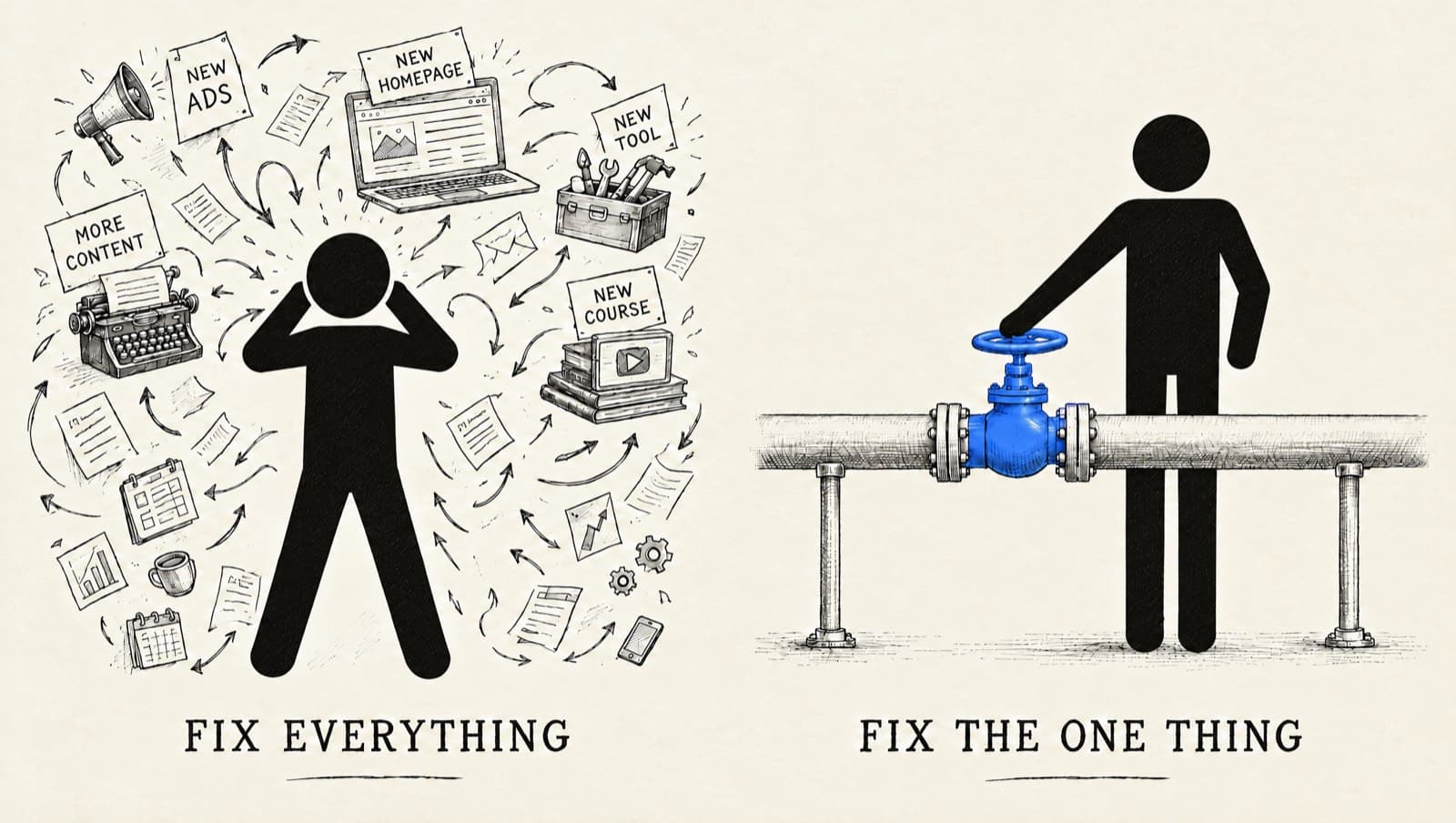
That isn't a work ethic problem. Most owners I meet work harder than anyone on their team. It's a diagnosis problem. When you can't see where the business is actually stuck, every fix feels equally urgent, so you try all of them.
And there's a second-order cost nobody talks about. Fixing the wrong thing doesn't only waste the effort. It often makes the real problem worse. More leads into an offer that doesn't convert means more ad spend, more sales calls that go nowhere and more people who heard your pitch and said no. You've paid to teach your market to ignore you.
Find the one number
Every online business moves people down the same path:
- Attention. Someone sees you.
- Leads. They raise their hand.
- Conversations. They book a call, watch you teach or read your sales page.
- Sales. They buy.
- Customers. They stay, buy again and tell others.
Each step has a number: cost per lead, lead to booked call, show rate, close rate, how long customers stay. Your constraint is the step where that number is weakest compared to what a healthy business in your market gets.
Two rules keep this honest.
Rank every drop in dollars, not percent. The biggest percentage drop is often not the most expensive one. A small lift on the step right before a $3,000 sale is worth more than a big lift on the step before a free download. Rank your leaks by the dollars they leave on the table.
Start at the money and work backward. If the offer isn't converting the people who already see it, buying more attention is the most expensive way to find that out.
When the number points at the offer
When I trace a stalled business back far enough, the constraint usually isn't traffic. It's the offer. Not the product itself, but the way it's offered.
That's why every diagnosis I run starts with the same five questions. I call it the 5-pillar framework.
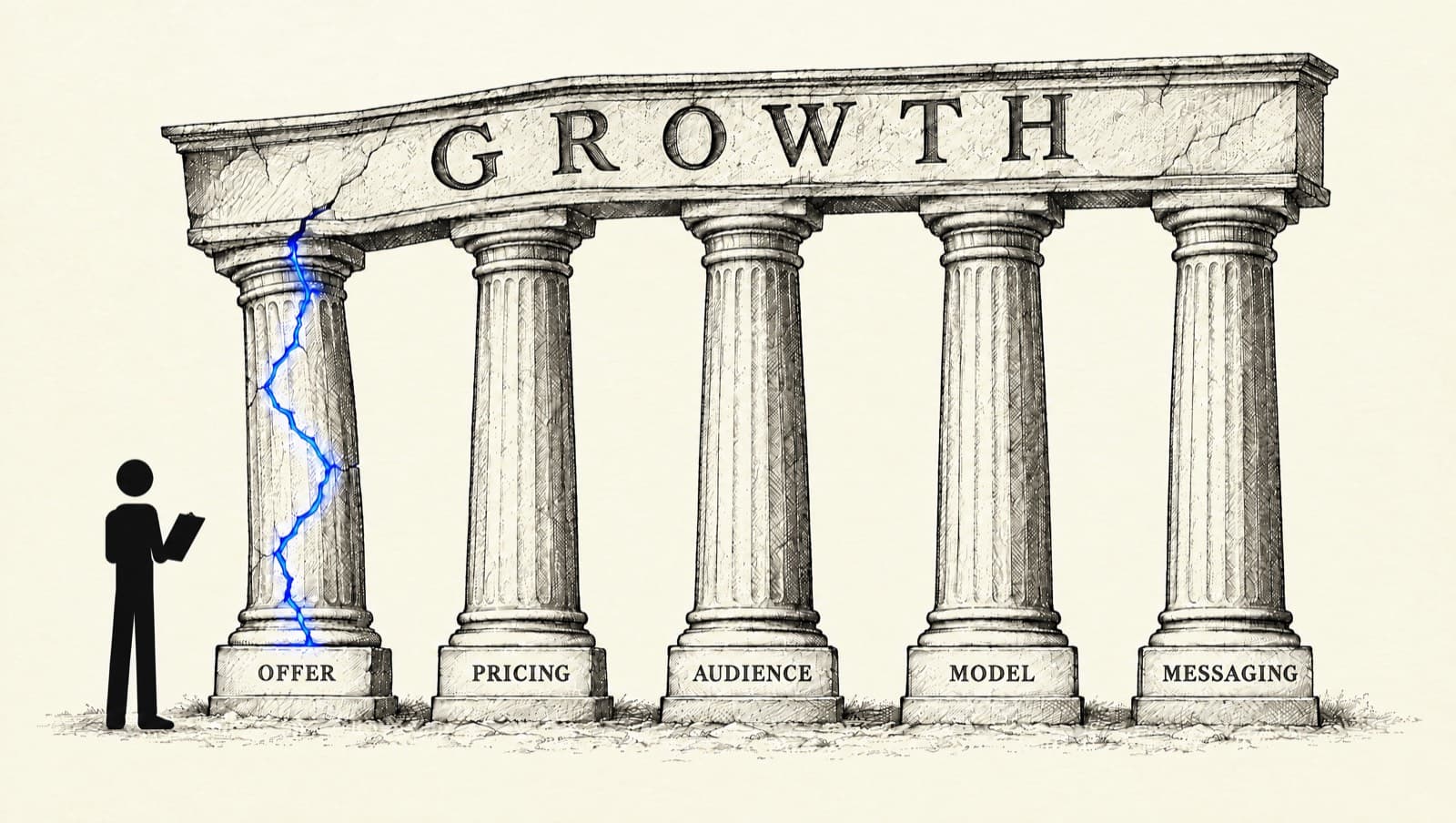
- Offer. Is it specific? Who exactly is it for, what exact result, in what timeframe? Vague offers don't lose on price. They lose on doubt.
- Pricing. Does the price match the certainty you've built? A higher price needs more proof, not more pressure.
- Audience. Are you in front of people who have the problem now, and the means to fix it?
- Model. How does the money actually come in: one payment, a plan, a subscription, a call? Is the path to the sale the right shape for the price?
- Messaging. Does what you say match what buyers already believe about their problem?
A weak pillar always shows up as a bad number further down the path. A vague offer shows up as a low close rate. The wrong audience shows up as cheap leads that never buy. The number tells you where to look. The pillars tell you why.
One example. A coaching program's webinar was converting at 1.7%. The instinct was more traffic. Instead we rewrote the opening to speak to the pain buyers actually had, not the one they said out loud. Same traffic, same price: it went to 6.2%. The constraint was the message, not the ads.
Fix one thing, then measure
Once you know the constraint, the discipline sounds obvious and is hard to keep. Change one thing. Give it enough traffic to read the result. Keep what wins. A loss is useful too: it permanently removes a dead end.
Then find the new constraint, because there always is one. Fixing the narrowest point reveals the next one. That isn't failure. That's what growth looks like from the inside.
Why this is hard to run on your own
None of this is complicated. So why don't more businesses run it?
Because it has to run every week, and it needs three things at the same time:
- Strategy. Knowing which number matters and what usually fixes it.
- Execution. Actually rewriting the offer, rebuilding the page, launching the test and following up with the leads.
- Numbers. One honest view of the path, from first click to money in the bank, so you can see what changed.
Software gives you tools and leaves the strategy to you. An agency gives you strategy, but you're renting it, and it walks out the door when the contract ends. AI chat will give you a great plan, and then it's on you to run it.
So most owners end up being the only place those three meet. Which is why the diagnosis happens in your head, at 11pm, once a quarter.
This is what Operator Mode was built to run
We built Operator Mode so those three things live in one place, with you directing them.
Plug your business in, and one machine handles your operations, acquires new customers and brings in new revenue, run by an Operator agent that knows your business. More than 25 jobs, handled by one very powerful machine dedicated to helping you strategically grow, scale and operate your online business.
- Strategy is built in. Operator Mode is built on the direct marketing and business systems behind 1,000+ campaigns and more than $200 million in verifiable results for online businesses. Its capabilities include the exact jobs in this post: finding your growth bottleneck and building an offer people say yes to.
- Your Operator agent does the work you direct. Ask for a sharper offer, a new sales page, a follow-up sequence or a test, and it builds it. You approve what goes live.
- The numbers live in one place. Revenue, leads, booked calls and sales, traced back to where they came from, so the next constraint is visible the week it appears.
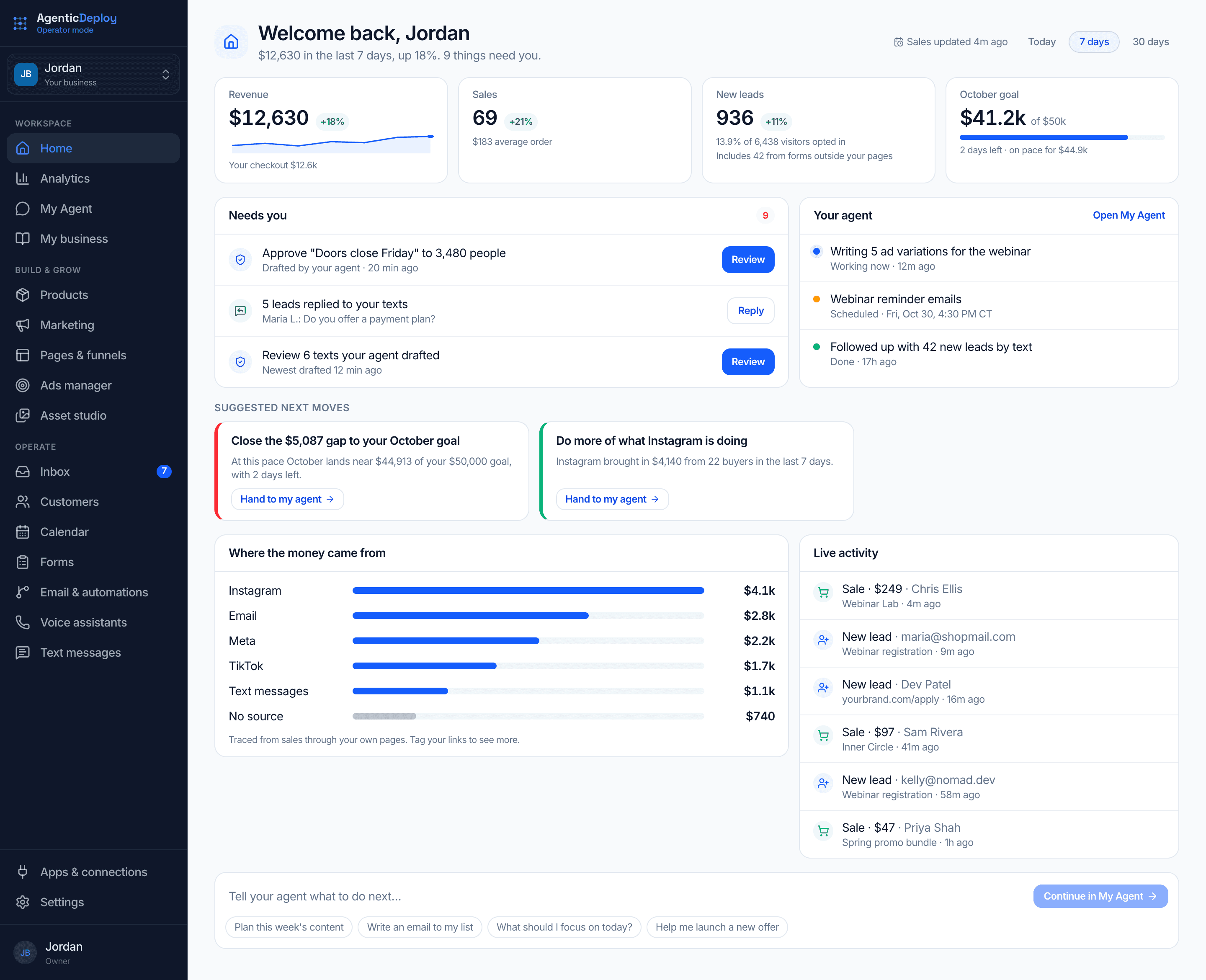
You stay the Operator. You decide what matters this week. The machine makes sure it actually gets done.
"Do I have to replace the tools I use?"
No. Keep the tools your team already lives in. Operator Mode connects to your CRM, your payment processor, your webinar platform, your calendar and your community. New leads flow into your current CRM with their tags, their details and how they found you. Purchases and bookings flow back to your ad account, so it learns from real buyers. Nothing has to be ripped out for the machine to start working.
If you're ready to work this way
Operator Mode is invite-only. We bring on a small number of businesses at a time, because each one is set up around its own offer and its own numbers.
The application takes about two minutes. Tell us what you sell and the numbers you know. We review it, and if there's a fit, we get on a short call and find your constraint together.
P.S. Not sure what your constraint is? That's the point of the application. Tell us the numbers you have, and we'll show you which one is missing.