Your Webinar Didn't Fail in the Room. It Failed in the Message.
A webinar is a sales argument, not an event. Why most are decided by the offer, the pain and the order of belief long before anyone joins, and how to build one that converts.
By Aaron Ball
Most owners think a webinar that didn't convert needs better slides, a stronger closer or more traffic.
The reality is that a webinar is a sales argument, not an event. It's decided by what you say, to whom, and in what order, long before anyone clicks the join link. The slides are just where the argument happens to be shown.
I've scored more than 500 businesses' webinars with the Webinar Profit Score, inside a career of 1,000+ campaigns. The gap between the ones that convert and the ones that don't is almost never talent or budget. It's structure.
The four places a webinar is actually won
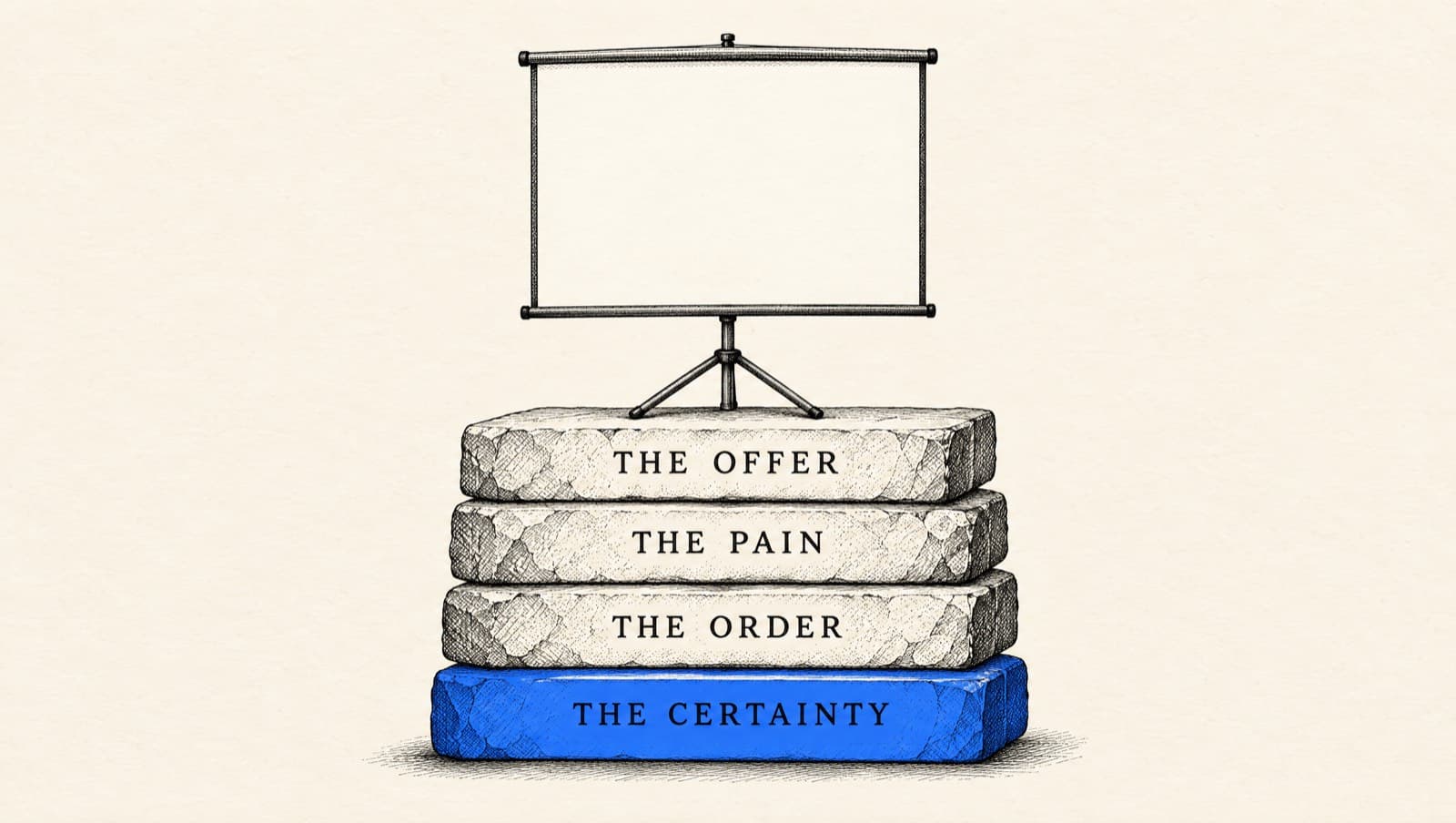
1. The offer
The first of the 4 Predictors I use to forecast how a webinar will convert is Offer Specificity: who exactly is it for, what exact result, in what timeframe. "Grow your business with AI" is a topic. "Book 20 more sales calls a month without hiring a setter, in the next 90 days" is an offer.
A vague offer attracts the wrong people, gives the right ones no reason to clear their calendar, and leaves everyone who stays to the end unsure what they'd actually be buying. No slide fixes that.
2. The pain
Most webinars speak to the pain people say out loud. That's the shallow version. Underneath it is the real pain, the reason it's acute right now, and the math of what happens if nothing changes. I map those four layers with the Pain Map before a single slide is written.
Here's what that's worth. A coaching program's webinar was converting at 1.7%. Same offer, same price, same traffic. We rewrote the opening to speak to all four layers of the pain instead of the one buyers said out loud. It went to 6.2%.
3. The order
People don't buy because they heard the right facts. They buy because their beliefs shifted in the right order: that the problem is bigger than they thought, that the old way can't fix it, that a new way exists, that it works for someone like them, and that now is the time.
Put the offer before those shifts happen and it feels like a pitch. Put it after and it feels like the obvious next step. Every webinar we build follows a 14-part structure for exactly this reason, from the hook through the paradigm shift, the mechanism and the proof to the offer, the price, the bonuses and the risk reversal.
4. The certainty
People don't buy the best offer. They buy the one that feels like the safest decision. I call this Proximity to Certainty, and it gets stronger as the price goes up: a higher price means more perceived risk, which means you need more certainty, not more pressure.
Certainty comes from specifics, proof that matches the size of the claim, a mechanism that explains why this works when other things didn't, and a guarantee or risk reversal that takes the fear off the table.
The words around the webinar sell too
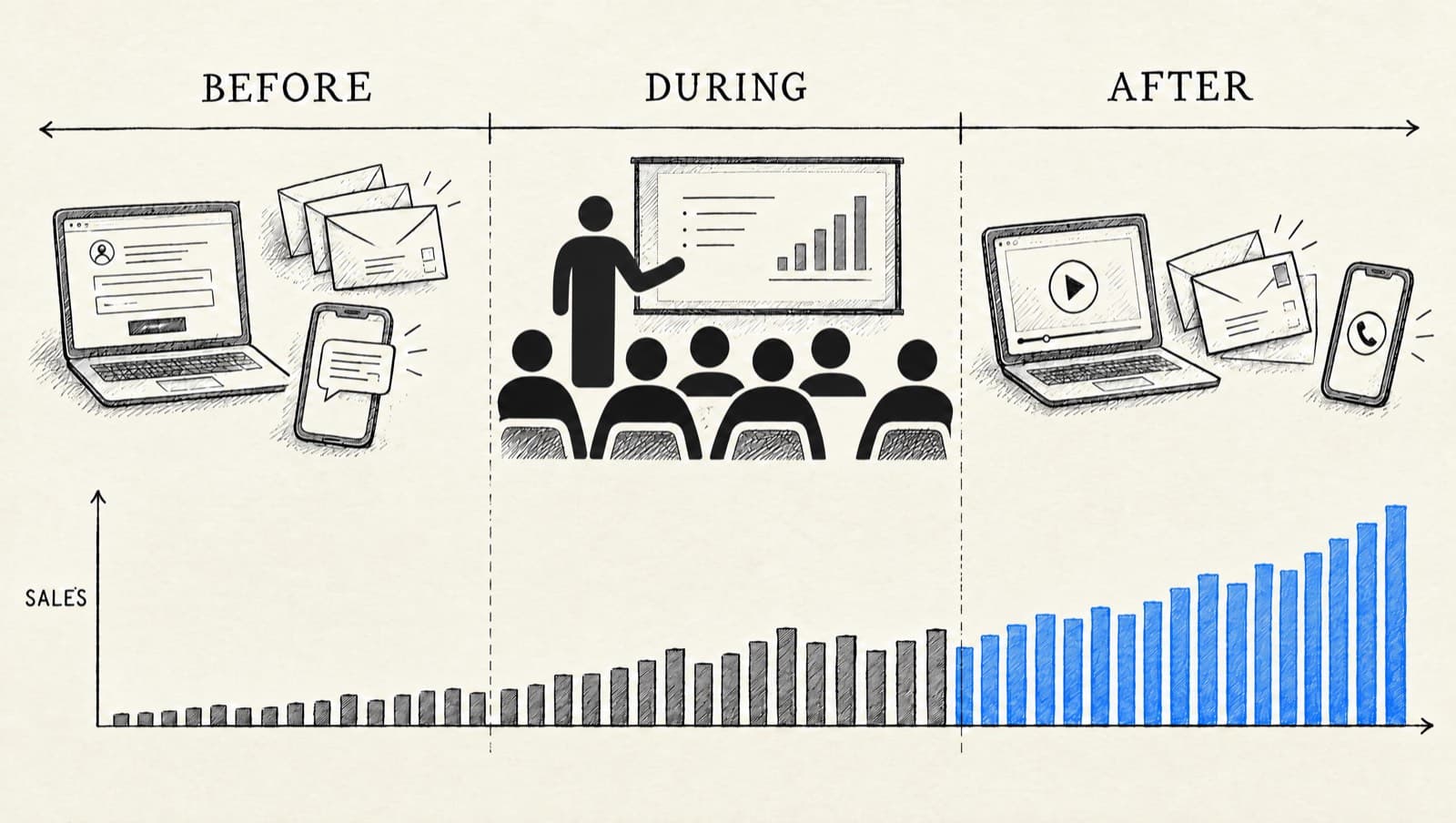
The webinar is one asset in a chain, and every link is copy:
- The registration page makes the promise. If it's vague, the wrong people sign up and the right ones scroll past.
- The confirmation page and reminders decide your show rate. Live attendance typically lands around a fifth to a third of registrants, and every point you move it is a point of revenue.
- The sales video sells to everyone who missed the live event. It needs the same argument, compressed.
- The follow-up emails carry the offer after the room closes, and in a well-run launch they and the replay often bring in a third or more of the sales.
If those pieces are written by different people, at different times, from different frameworks, the argument breaks between them.
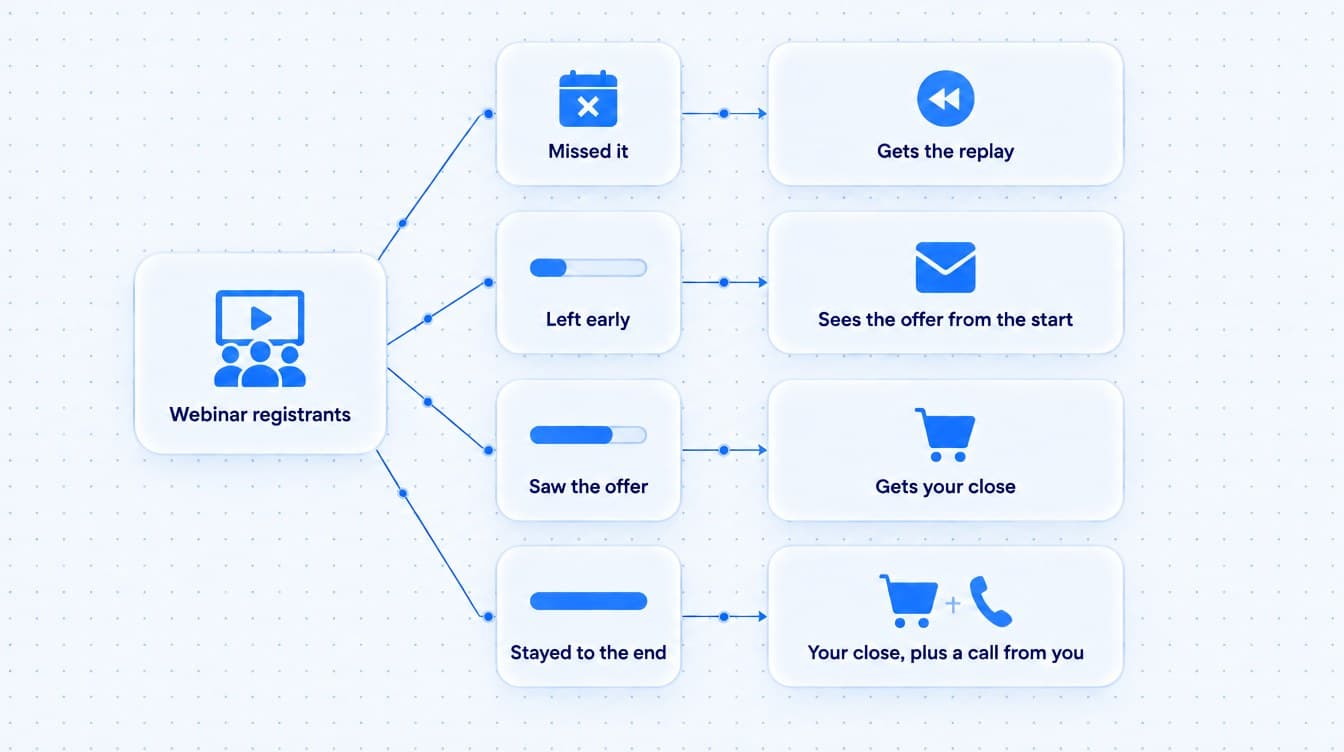
Then the follow-up has to know who watched what
The people who stayed to the end get your close and a personal call. The people who saw the offer get your close while it's fresh. The people who left early get the offer from the start. The people who missed it get the replay and a reason to watch now. One message for everyone treats your best buyers like your coldest.
This is what Operator Mode was built to run
Plug your business in, and one machine handles your operations, acquires new customers and brings in new revenue, run by an Operator agent that knows your business. More than 25 jobs, handled by one very powerful machine dedicated to helping you strategically grow, scale and operate your online business.
For a webinar, your Operator agent writes and builds the whole argument with you, following the frameworks behind 1,000+ campaigns and more than $200 million in verifiable results for online businesses:
- The offer. It builds an offer people say yes to: who it's for, the exact result, the timeframe and the reasons to believe it.
- The webinar itself. An event brief, a minute-by-minute run of show, and slide-by-slide content: the headline, the on-screen text and what you say, through an honest transition to your offer.
- The copy around it. Registration and sales pages, your sales video script, ads and the email sequence, each written for where your reader is right now, with every claim checked against what you can prove.
- The delivery. Registration pages live on your own domain, reminders by email and text, watch time on every contact read from your webinar platform, and follow-up that splits by what each person actually watched.
- The numbers. Registrations, show rate, applications, booked calls and sales, traced back to the ad that brought each person in.
You stay the Operator. You choose the offer, approve the message and decide what goes live. The machine writes it, builds it and runs it.
"I already have a webinar platform"
Keep it. Operator Mode connects to the webinar platform you already use and reads attendance and watch time back onto each contact, so the follow-up knows exactly who saw what.
If your webinars should be converting better
Operator Mode is invite-only, and we bring on a small number of businesses at a time.
The application takes about two minutes. Tell us what you sell on your webinar, how often you run it and roughly how many people show up live. On the call, we'll show you where the argument is breaking.
P.S. Read the first two minutes of your last webinar out loud. If it describes the pain your buyers say instead of the pain they actually feel, you've found the first thing to fix.